

Post-Occupancy Technology Evaluation: A Strategic Checklist for Modern Workplaces
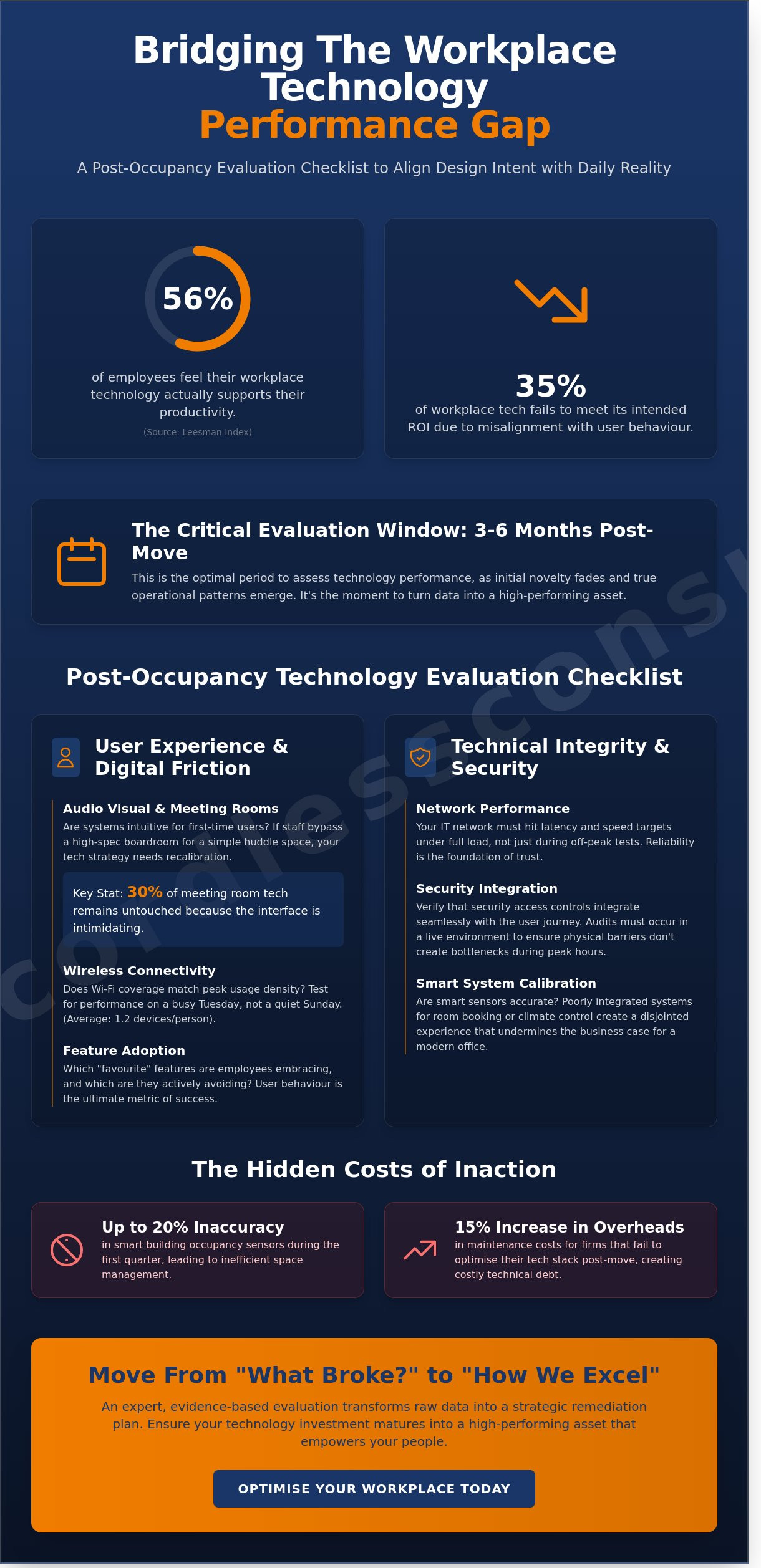
The most expensive mistake a London firm can make isn’t a poor design choice; it’s assuming that day-one installation equals long-term performance. You’ve likely invested heavily in a seamless digital infrastructure, yet research from the Leesman Index suggests that only 56% of employees believe their workplace technology supports their productivity. It’s frustrating to see smart building sensors providing inaccurate occupancy data or premium hardware sitting underutilised while teams struggle with basic hybrid meetings. By conducting a professional post-occupancy technology evaluation London organisations can finally bridge the gap between initial design intent and actual daily performance.
We believe that technology should be an invisible enabler rather than a source of friction. This article provides a rigorous framework to help you validate your technology spend and fix hidden issues before they evolve into costly technical debt. You’ll learn how to transform your workplace into a high-performing environment by following a strategic checklist that prioritises user-centric design and operational efficiency. We’ll explore how a structured technology audit allows you to optimise the workplace journey and ensure your infrastructure truly serves your people.
The Performance Gap: Why Technology Handover is Only the Start
Handover marks a milestone, but it isn’t the finish line for a successful workplace project. A post-occupancy technology evaluation London provides a systematic, evidence-based audit of IT, AV, and smart systems in their live environment. This process is designed to bridge the ‘Performance Gap,’ the measurable discrepancy between original design specifications and the reality of daily user behaviour. Industry data from 2023 indicates that 35% of workplace technologies fail to meet their intended ROI because they don’t align with how employees actually interact with the space.
The 3 to 6-month window after a move is the critical period for this assessment. It’s the point where initial novelty fades and true operational patterns emerge. A comprehensive Post-occupancy evaluation relies on a resilient IT physical infrastructure as its foundation. If the underlying cabling and hardware foundations are weak, even the most advanced software applications will struggle to deliver their promised value. We view this evaluation as a strategic recalibration, ensuring your investment matures into a high-performing asset.
Identifying ‘Teething Issues’ in Smart Buildings
Smart buildings aren’t always intelligent on day one. Sensor networks frequently suffer from initial calibration errors, with occupancy tracking showing inaccuracies of up to 20% in high-traffic zones during the first quarter of use. When smart building systems are poorly integrated, employee productivity suffers. Friction in room booking or climate control creates a disjointed workplace journey that alienates talent and undermines the business case for a modern office.
The True Cost of Underutilised Infrastructure
Technical debt is a hidden tax on commercial real estate. Every ignored friction point or bypassed system adds to long-term operational inefficiency. If infrastructure remains underutilised, the organisation isn’t just wasting square footage; it’s burning capital. In 2024, London firms that fail to optimise their tech stack post-move see a 15% increase in maintenance overheads. Identifying these inefficiencies early prevents small technical glitches from hardening into permanent, costly obstacles.
Your Post-Occupancy Technology Evaluation Checklist
Moving from a completed project to an optimised workplace requires a structured audit framework. This isn’t a mere snag list; it’s a strategic roadmap that aligns technical performance with the human experience. High-level technical project management ensures these audits are coordinated across departments without disrupting daily operations. A successful post-occupancy technology evaluation London businesses can rely on uncovers the gap between design intent and actual usage.
User Experience and Digital Friction
Technology only adds value if it’s effortless. In many London offices, 30% of meeting room tech remains untouched because the interface feels intimidating. This Post Occupancy Evaluations guide highlights that user productivity is the ultimate metric of success. Your audit should answer these questions:
- Are audio visual systems intuitive for first-time users, or do they require a manual?
- Does Wi-Fi coverage match the density of a busy Tuesday, accounting for the 1.2 devices-per-person average?
- Which ‘favourite’ features are employees embracing, and which ones are they actively avoiding?
If staff bypass a high-spec boardroom for a simple huddle space, your tech strategy needs recalibration to match real-world habits.
Technical Integrity and Security Performance
Reliability is the foundation of trust. Your IT network must hit latency targets under full load, not just during a quiet Sunday test. Security is equally critical. You must verify that security access controls integrate seamlessly with the user journey. Security audits must happen in a live environment to be valid. This ensures that physical barriers don’t create bottlenecks at the lift lobby or reception during peak hours.
Snagging is common; strategy is rare. As your expert guide, we help you bridge the gap between initial design and the daily reality of your workplace journey.
Optimising the Workplace Journey: From Data to Strategic Action
Data without action is just overhead. A post-occupancy technology evaluation London transforms raw metrics into a high-impact remediation strategy. Leaders often treat evaluations as post-mortems, yet they’re actually the first step of your next evolution. Instead of merely listing faults, we focus on strategic fixes that bridge the gap between technical design and the human experience. It’s about shifting from “what broke” to “how we excel” through evidence-based adjustments. By 2025, a projected 70% of London offices will require significant technological refreshes to accommodate hybrid workflows; using POE data now ensures those refreshes are targeted and cost-efficient.
Turning Insights into a Future-Proof Roadmap
Prioritise remediation by measuring friction against business goals. If 35% of your staff report audio failures in hybrid meetings, that’s a priority one fix. This data-driven approach ensures your next office expansion or floor fit-out doesn’t repeat the technical debt of the last. It refines your future strategy, making every infrastructure decision more effective. By documenting these lessons, you create a living blueprint for the modern workplace that evolves with your workforce. This intelligence informs your technical project management for future expansions, ensuring you avoid costly retrofits by getting the design right the second time around.
The Advantage of Independent, Vendor-Neutral Advice
Original installers often overlook systemic issues because they’re tethered to specific hardware or legacy configurations. Independent audits provide the objective clarity needed to see through the “business as usual” fog. Our “cordless” philosophy removes hardware bias, focusing purely on performance and user outcomes. It’s about untethering your organisation from restrictive systems that no longer serve your needs. We provide the technical authority to challenge the status quo, ensuring your technology serves your people, not the other way around. This independent perspective is the only way to guarantee that your remediation plan is based on merit rather than manufacturer quotas.
Ready to move from data to action? Contact Cordless Consultants to arrange your independent technology evaluation and future-proof your London workplace.
Maximising Your Workplace Technology Investment
A successful office launch is just the start of your workplace journey. Bridging the performance gap requires moving beyond the initial handover to ensure systems truly support your people. By applying a rigorous checklist, you’ll turn operational data into strategic actions that optimise the user experience and drive long-term efficiency. It’s the difference between a static environment and a dynamic, evolving hub.
Cordless Consultants brings 30+ years of independent consultancy experience to the table. Our team has a proven track record in enterprise-level transitions, delivering integrated solutions across IT, AV, Security, and Smart Buildings. When you commission a post-occupancy technology evaluation London, you’re not just checking boxes; you’re securing the long-term health of your digital estate. We’ve navigated complex challenges for global organisations, ensuring their infrastructure remains resilient and user-centric. It’s time to ensure your technology works as hard as your employees do.
Ready to align your infrastructure with your strategic goals? Book a vendor-neutral technology audit with Cordless Consultants today. Let’s build a smarter, more connected future for your team.
Frequently Asked Questions
What is the best time to conduct a post-occupancy technology evaluation?
The optimal window for a post-occupancy technology evaluation London project is between 3 and 6 months after the initial move-in. This period ensures that at least 90% of staff have engaged with the new systems, allowing teething issues to surface while the original project objectives remain fresh. Data gathered during this phase provides a realistic snapshot of how the technology supports the daily workplace journey and identifies necessary refinements.
How does a technology POE differ from a standard building audit?
While a standard building audit focuses on physical assets and snagging, a technology POE examines the invisible layer of connectivity and user experience. We evaluate how 100% of the integrated systems, from AV to smart sensors, actually perform under real-world pressure. It’s a strategic shift from checking if a device is present to measuring if it’s truly fit for purpose and driving business value for the organisation.
Can a POE help reduce our long-term technical debt?
A thorough evaluation identifies underperforming assets, potentially reducing technical debt by 15% to 20% through the consolidation of redundant systems. By uncovering features that staff find too complex, we help organisations pivot toward simpler, more efficient solutions. This strategic alignment ensures your future investments focus on high-impact tools rather than maintaining legacy friction points that hinder productivity and frustrate your talented workforce.
What are the most common technology failures found in new London offices?
The most frequent failures in London offices involve hybrid meeting equity and poor integration between room booking software and physical occupancy sensors. Recent industry data indicates that 40% of meeting room technology fails to meet user expectations during the first 90 days. These friction points often stem from a disconnect between the initial design intent and the actual habits of a modern, flexible workforce in a high-pressure environment.