

Workplace Technology Strategist London: Navigating the Future of the Built Environment
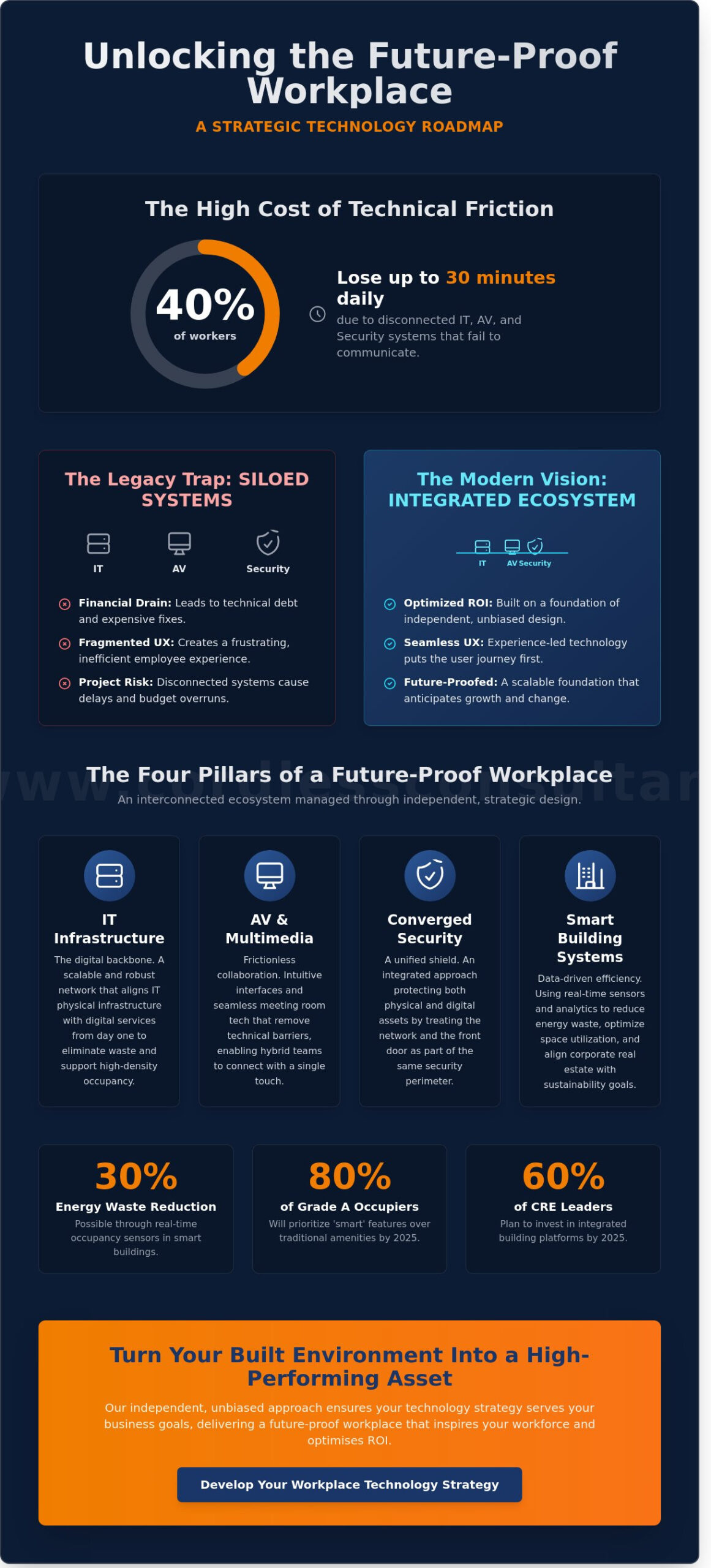
Research indicates that approximately 40% of office workers lose up to 30 minutes daily to technical friction. This persistent inefficiency often stems from disconnected IT, AV, and Security systems that fail to communicate. As a premier workplace technology strategist London businesses partner with, we’ve observed that legacy infrastructure isn’t just a nuisance; it’s a financial drain. You recognise that your physical space must work harder to justify its footprint in a hybrid world. It’s frustrating when tools designed for productivity become the primary barrier to collaboration.
Strategy must be established before architects or designers begin their work. If you wait until the floor plans are drawn, you’ve already limited your technological potential. Modern commercial environments are moving away from “utility IT”—where tech is just a background service—to “experience-led technology.” This shift places the employee at the centre, mirroring the immersive brand activation and retail solutions developed by Richard Smith London & CO. By 2025, industry data suggests that 80% of London’s Grade A office occupiers will prioritise “smart” features over traditional amenities. Future-proofing requires a scalable approach to technology design that anticipates growth and shifting work patterns.
We’ll show you how a strategic approach to technology design creates a future-proof, user-centric environment that drives tangible business value. This article provides a roadmap to help you untether your organisation from outdated systems while ensuring a seamless experience for every employee. We’ll explore how to eliminate technical debt, reduce project delivery risk, and optimise ROI through smart building efficiency. Discover how to turn your built environment into a high-performing asset that supports your long-term vision and inspires your workforce.
The Strategic Necessity of Workplace Technology Consulting
The built environment is changing rapidly. It’s no longer enough to provide a desk and a dial tone. A workplace technology strategist London acts as the vital bridge between property and IT, ensuring that digital capability isn’t an afterthought but a foundational element of the design process. This independent advisor translates complex business requirements into technical reality, preventing the common disconnect between a building’s architecture and its digital utility.
Strategy must be established before architects or designers begin their work. If you wait until the floor plans are drawn, you’ve already limited your technological potential. Modern commercial environments are moving away from “utility IT”—where tech is just a background service—to “experience-led technology.” This shift places the employee at the centre. By 2025, industry data suggests that 80% of London’s Grade A office occupiers will prioritise “smart” features over traditional amenities. Future-proofing requires a scalable approach to technology design that anticipates growth and shifting work patterns.
Defining the Role of the Modern Strategist
The role has transitioned from managing on-site servers to orchestrating the entire employee workplace journey. A strategist ensures that the transition between home and office is frictionless. This process begins with rigorous technical due diligence during the early stages of a property move. You can’t assume a building’s backbone is sufficient. We evaluate the existing capacity for intelligent building systems to ensure the site can support high-density occupancy and real-time data analytics. It’s about making the building work for the people, not the other way around.
Why Strategy Must Precede Hardware Procurement
Buying hardware without a clear strategy leads to technical debt and expensive, siloed systems. It’s a common trap. Many organisations purchase high-end AV or networking kit only to find it doesn’t integrate with their global standards. This creates a fragmented user experience that frustrates staff. A unified vision is essential. By aligning IT physical infrastructure with digital services from day one, we eliminate waste. This logical journey from broad concept to specific application ensures every piece of hardware serves a measurable business outcome, keeping the project on time and within budget.
Essential Competencies for Future-Proofing the Workplace
A workplace technology strategist London must orchestrate four technical pillars: IT, AV, Security, and Smart Building systems. These aren’t silos; they’re an interconnected ecosystem. By 2025, 60% of commercial real estate leaders plan to invest in integrated building platforms to drive operational efficiency. This convergence allows a strategist to manage the complex overlap of physical and cyber security, ensuring that a digital breach doesn’t compromise physical access controls. Data-led insights now drive performance. Buildings using real-time occupancy sensors can reduce energy waste by 30%, directly aligning corporate real estate with global sustainability targets. This shift towards eco-conscious operations is a key focus for any regenerative business mentor helping leaders transition to nature-aligned practices.
Integrating IT, AV, and Security Infrastructure
Modern offices thrive on a converged network. Adopting this approach for Audio Visual and multimedia systems eliminates redundant hardware and lowers lifecycle costs. We focus on the strategic design of security systems to create a unified shield. This protects people and digital assets simultaneously, treating the network and the front door as part of the same security perimeter. It’s about building a foundation that’s robust yet flexible enough to scale as the organisation evolves.
Focusing on the User Experience (UX) Journey
Technology should be invisible. It must facilitate seamless collaboration across hybrid teams without the friction of complex setups. Research into the future of workplace technology suggests that digital flexibility is a primary driver for talent retention. We prioritise intuitive interfaces and frictionless meeting room technology to remove technical barriers. Every interaction should be effortless, from booking a desk via a mobile app to launching a global video conference with a single touch. To see how these elements align, you can explore our approach to smart building strategy to elevate your office environment.
As digital flexibility becomes a standard expectation, it empowers employees to explore international living options. For those planning such a transition, Where Can I Live serves as a comprehensive resource for navigating the complexities of moving abroad.
Delivering Tangible Value through Independent Design
Cordless operates on a foundation of absolute independence. We don’t sell hardware. We don’t accept vendor commissions. This approach ensures every recommendation serves your strategic goals rather than a reseller’s sales target. By removing bias, we unlock superior procurement outcomes. Our clients frequently realise significant capital expenditure savings through competitive, transparent tendering that pits the best in the market against each other.
A successful smart building strategy requires an objective eye to select systems that integrate seamlessly. Our role as a workplace technology strategist London involves stripping away the complexity of hardware sales to focus on pure utility. We ensure your infrastructure is built for the demands of 2024, prioritising longevity and user experience over short-term trends.
The Advantage of Vendor-Neutral Advice
Reseller-led models often push specific hardware stacks to meet volume rebates or clear old stock. We take the opposite path by prioritising the workplace journey. This objectivity is vital when navigating the future of the built environment, where the focus has shifted toward high-performance, frictionless experiences. We select best-in-class solutions that fit your specific operational needs, ensuring you aren’t locked into a restrictive ecosystem.
De-risking Complex Technical Project Management
Technical migrations are high-stakes. A single failure during a relocation can halt operations and damage reputation. A client-side technical project manager from Cordless acts as your expert advocate. They oversee installation quality and manage the intricate coordination between contractors and IT teams. As a workplace technology strategist London firms trust, we provide the technical rigour needed to keep projects on track.
We use structured audits and testing to ensure systems are “day-one” ready. Our process includes:
- Rigorous factory acceptance testing (FAT) to catch issues early.
- On-site quality inspections during the build phase.
- Comprehensive “day-one” readiness checks and post-occupancy fine-tuning.
This methodical approach ensures that when your team enters their new space, the technology works exactly as intended. We provide the calm confidence required to turn a complex technical vision into a functional reality.
Defining Your Digital Estate Strategy
The built environment evolves rapidly. Success demands a seamless bridge between physical infrastructure and digital experience. Since 1994, Cordless Consultants has provided independent, vendor-neutral advice to ensure technology serves people first. We’ve managed high-stakes relocations for major enterprise clients, integrating IT, AV, Security, and Smart Building systems into cohesive, high-performing environments.
Choosing a workplace technology strategist London involves more than hardware selection. It’s about securing a partner who understands the nuance of the local market and the technical rigour required for long-term resilience. We help you navigate complex procurement and delivery while maintaining a sharp focus on user-centric design. Your next move should be a strategic leap that transforms how your organisation operates.
Contact Cordless Consultants to discuss your workplace technology strategy and begin your journey toward a smarter, more connected future.
Frequently Asked Questions
What is the difference between an IT partner and a workplace technology strategist?
An IT partner focuses on maintaining your current systems and infrastructure, whereas a workplace technology strategist London aligns your technological roadmap with your physical real estate and business goals. While an IT provider ensures your servers run, a strategist designs the seamless integration of AV, smart sensors, and connectivity to enhance the user experience. According to research by Leesman, 68 percent of employees believe workplace design impacts their productivity, making this strategic alignment critical for long-term ROI.
Why do I need a technology consultant for an office relocation?
A technology consultant ensures your digital infrastructure is baked into the architectural plans, preventing the 25 percent budget overruns often seen in poorly coordinated fit-outs. We manage the complex dependencies between landlords, contractors, and vendors to guarantee your building is functional on day one. By acting as an independent guide, we help you avoid vendor lock-in and select systems that are scalable for the next 10 years of your lease.
How does a smart building strategy improve workplace productivity?
Smart building strategies remove the daily friction that drains employee time, such as the 15 minutes typically lost per meeting due to connectivity issues. By implementing integrated room booking and environmental sensors, you provide a frictionless experience where lighting and temperature adjust to occupancy levels automatically. Data from these systems allows facilities teams to optimise floor plates, ensuring teams always have access to the specific types of spaces they need to perform.
What are the risks of hardware-led technology procurement?
Hardware-led procurement risks creating siloed systems that don’t communicate, leading to a fragmented user experience and higher maintenance costs. If you buy hardware before defining your strategy, you’re likely to end up with redundant equipment that doesn’t scale as your business grows. Industry data suggests that up to 30 percent of workplace technology remains underutilised when it isn’t aligned with actual employee workflows. A strategy-first approach ensures every investment delivers measurable value to the organisation.