

Technology Lifecycle Management for Corporate Offices: A Strategic Framework
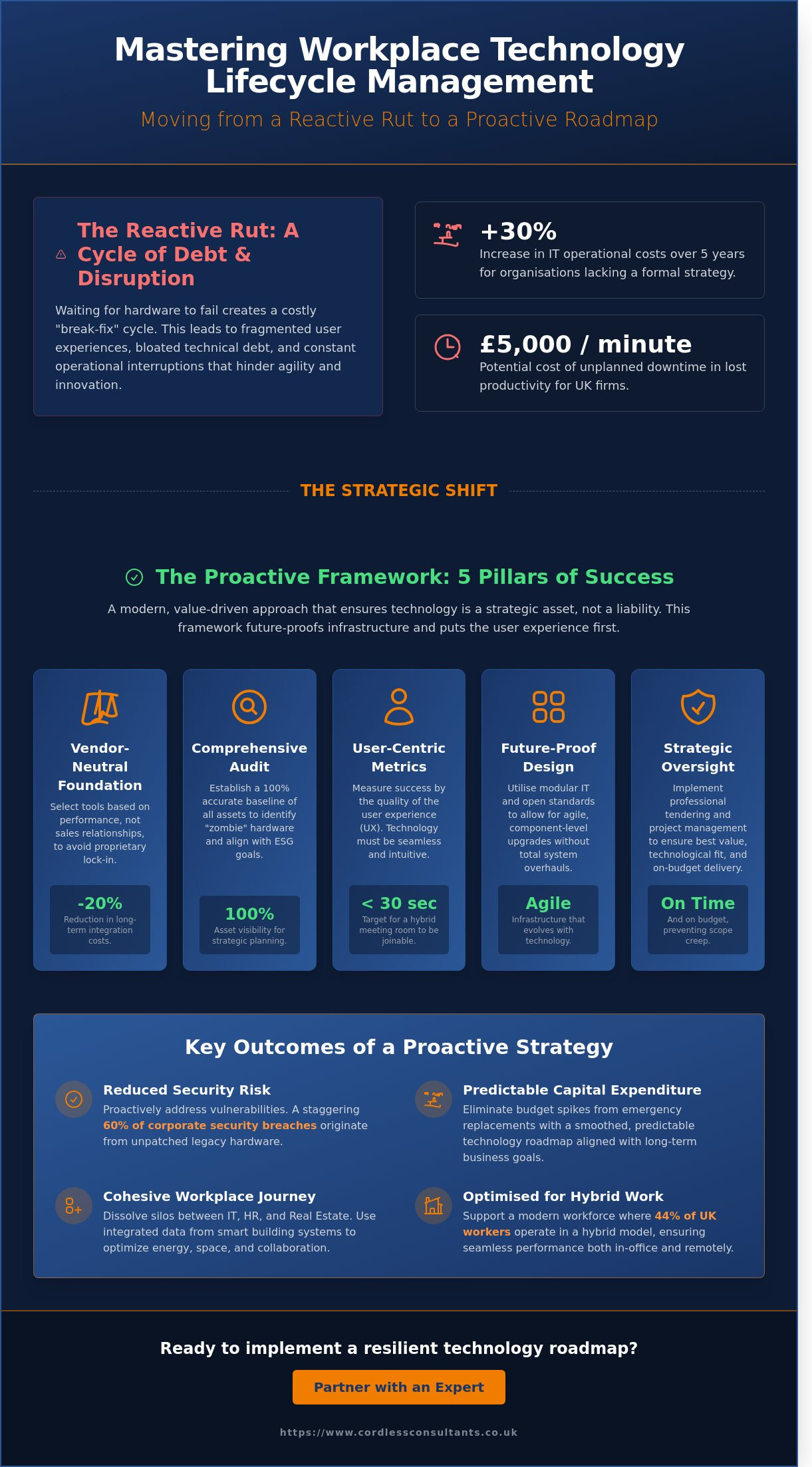
How much of your current workplace technology is actually an asset, and how much is merely a liability waiting to disrupt your operations? You likely recognise that reactive hardware procurement creates bloated technical debt and fragmented user experiences across different zones. A 2023 industry report suggests that organisations lacking a formal strategy see IT operational costs rise by 30% over a five-year period. Implementing robust technology lifecycle management for corporate offices is no longer just an IT task; it’s a strategic necessity to ensure agility, security, and long-term value.
We agree that the constant cycle of emergency replacements is both exhausting and expensive for any forward-thinking organisation. This framework promises to help you master these complexities by moving toward a proactive, value-driven approach. You’ll gain the insights needed to establish a predictable technology roadmap that reduces operational risk and future-proofs your smart building infrastructure. We’ll examine the specific stages required to transition from fragmented systems to a seamless, integrated workplace journey that puts your people first.
Redefining Technology Lifecycle Management for the 2026 Workplace
Effective technology lifecycle management for corporate offices is no longer a back-office procurement exercise. It’s a continuous strategic process that ensures digital infrastructure remains an asset rather than a liability. By 2026, the traditional 3-5 year “break-fix” refresh cycle has become obsolete. This shift is driven by the rapid compression of the Technology life cycle and a move toward sustainable, circular economies. Waiting for hardware to fail before acting creates unnecessary risk and inhibits innovation.
Modern workplaces focus on integrated experiences rather than individual devices. Success is measured by how a sensor in a meeting room communicates with the HVAC system and the user’s booking app to create a seamless environment. With 44% of UK workers currently operating in a hybrid model according to ONS data, infrastructure demand is volatile. Asset tracking now extends beyond the office walls, requiring robust, cloud-based systems to manage hardware across thousands of domestic locations while maintaining security and performance standards.
The Cost of Reactive Technology Management
Reactive management is expensive. Waiting for hardware to fail before replacing it creates technical debt that hinders agility. Unplanned upgrades often disrupt business continuity and inflate budgets by up to 30% compared to structured, proactive refreshes. In high-stakes environments, unplanned downtime can cost UK firms upwards of £5,000 per minute in lost productivity. A strategic technology lifecycle management for corporate offices programme eliminates these spikes, providing a predictable, smoothed capital expenditure profile that aligns with long-term business goals.
Bridging the Gap Between IT and Facilities
Modern lifecycle management requires a unified front. The silos between IT, HR, and Real Estate must dissolve to create a cohesive workplace journey. Smart building systems now act as the central nervous system for this collaboration, centralising data on occupancy and performance. This integrated data allows teams to realise efficiencies in energy use and space planning. By using real-time analytics, organisations can ensure the physical environment evolves at the same pace as the digital tools within it, creating a future-proof workplace that supports high-performance teams.
The Strategic Pillars of a Vendor-Neutral Lifecycle
Objective guidance is the bedrock of effective technology lifecycle management for corporate offices. Without vendor bias, you focus on what actually works for your specific square footage and headcount. A 2023 industry analysis suggests that organisations prioritising vendor-agnostic architectures reduce long-term integration costs by up to 20%. This independence allows you to select tools based on performance rather than existing sales relationships.
Procurement must align with broader business goals and ESG targets. In the UK, the SECR (Streamlined Energy and Carbon Reporting) framework makes energy efficiency a boardroom priority. We align your hardware refresh cycles with these mandates to ensure your estate remains modern and compliant. You can’t manage what you haven’t measured, so a comprehensive technology audit is the first step. It establishes a 100% accurate baseline of your current assets, identifying “zombie” hardware that consumes power without providing value.
The ultimate metric for success isn’t just system uptime; it’s user experience (UX). If a hybrid meeting room takes more than 30 seconds to join, the technology has failed, regardless of its technical specifications. This methodical approach ensures your smart building strategy delivers tangible value from day one.
Designing for Flexibility and Scalability
Modular IT infrastructure is essential to future-proof corporate spaces. You shouldn’t be trapped in proprietary ecosystems that lock you into a single manufacturer for five or ten years. By choosing open standards and vendor-agnostic systems, you gain the freedom to swap individual components as new innovations emerge. This agility keeps your workplace journey at the cutting edge without requiring a total system overhaul every refresh cycle.
Procurement and Tendering Oversight
Strategic tendering ensures you receive the best market value and the right technological fit. It’s about more than just the lowest bid. It’s about finding a partner who understands your culture. Professional client-side project management is vital during complex migrations. It provides the technical rigour needed to prevent scope creep, ensuring multi-million pound refreshes stay on schedule and within budget.
Managing Technical Debt and Future-Proofing Infrastructure
Technical debt isn’t just an accounting entry; it’s a physical drag on workplace productivity. In many UK offices, legacy AV systems, outdated security protocols, and siloed data streams create friction that hampers growth. Effective technology lifecycle management for corporate offices identifies these bottlenecks before they reach a breaking point. Use a risk-based framework to prioritise upgrades. Map every system against its business impact and the likelihood of failure. A 2023 industry report indicated that 60% of corporate security breaches originated from unpatched legacy hardware. In a converged environment, regular firmware and software updates are your primary defence against obsolescence.
- Identify legacy AV and siloed data sources.
- Prioritise based on risk and business continuity.
- Maintain a rigorous schedule for firmware patches.
- Audit third-party integrations to ensure ecosystem health.
The Smart Building Advantage
IoT sensors and real-time data analytics transform how we view hardware longevity. Instead of relying on arbitrary replacement cycles, intelligent systems predict when a component requires maintenance. This proactive approach can reduce the long-term cost of technology ownership by 15% through targeted interventions. Smart building strategy also enables precise energy optimisation. By linking occupancy data with building management systems, you ensure that infrastructure only works when it’s needed, extending the life of your assets.
Risk Mitigation in Technology Migration
Office relocations and transitions are high-risk periods for data security. Decommissioning legacy hardware requires more than just clearing a desk; it demands strict data destruction protocols to remain compliant with UK GDPR. During migration, maintain a clear audit trail for every asset. Seamless transitions rely on detailed migration management that bridges the gap between old and new environments. This rigour protects your intellectual property and ensures security standards don’t slip during the chaos of a move.
Is your current infrastructure holding you back? Consult with our independent experts to audit your technology lifecycle today.
Implementing a Resilient Technology Roadmap with Cordless
Effective technology lifecycle management for corporate offices requires more than a procurement list; it demands a vendor-neutral strategy. Cordless Consultants Limited provides an approach rooted in independent design and project management. We don’t sell specific hardware, which allows us to focus entirely on your operational goals. This independence ensures your infrastructure serves your business needs rather than a manufacturer’s sales quota.
Our technology audits deliver the data the C-suite needs for informed decision-making. We’ve seen organisations identify up to 22% in redundant hardware costs by simply gaining visibility into their current estate. By moving away from transactional service contracts and towards a long-term strategic partnership, you gain a partner invested in your continuous evolution. We provide a steady hand to navigate technical shifts, ensuring your investment remains relevant for years to come.
From IT Strategy to Workplace Reality
We specialise in translating complex technical requirements into high-performing corporate environments. It’s about ensuring the underlying infrastructure supports the human experience at every touchpoint. You can learn more about our methodology regarding Strategic IT Strategy & Design for London’s Modern Workplaces. We bridge the gap between abstract digital goals and the physical reality of a productive office, creating a seamless journey for your staff and visitors alike.
Your Next Steps in Lifecycle Optimisation
Optimising your technology lifecycle starts with a comprehensive review of your existing IT, AV, and security systems. A holistic audit provides the baseline for any future-proof roadmap. We invite you to contact Cordless Consultants Limited for an independent technology audit to uncover hidden efficiencies and mitigate the risks of legacy systems.
- Assess: Gain a clear picture of your current technological health.
- Align: Ensure your IT spend matches your long-term business strategy.
- Act: Implement a managed roadmap that evolves with your workplace.
Future-proof your workplace journey with expert consultancy. Reach out to the Cordless Consultants Limited team today to start your transition from reactive maintenance to strategic innovation.
Future-Proof Your Workplace Strategy
Building a resilient office environment requires moving beyond short-term fixes toward a structured, visionary approach. By 2026, the demand for integrated smart systems will make outdated infrastructure a significant liability for any business. Implementing robust technology lifecycle management for corporate offices allows your organisation to clear technical debt while prioritising the human experience. Success depends on total objectivity in procurement and design. Since 1994, Cordless has provided independent, vendor-neutral consultancy across IT, AV, Security, and Smart Buildings. We’ve managed some of the UK’s most complex corporate relocations, ensuring technology serves as a catalyst for change rather than a constraint. It’s time to move from surviving the tech cycle to mastering it. Our experts provide the strategic clarity needed to navigate this journey with confidence.
Optimise your workplace technology with an independent audit from Cordless
Let’s work together to create a workplace that inspires your people and empowers your business.
Frequently Asked Questions
What is the ideal refresh cycle for corporate office technology?
The ideal refresh cycle for most corporate office technology spans three to five years for end-user devices and five to seven years for core infrastructure. Research indicates that hardware performance often degrades by 22% annually after the third year of use. By adhering to these cycles, organisations maintain peak productivity and ensure software compatibility. This proactive approach to technology lifecycle management for corporate offices prevents the sudden, high-cost failures associated with sweating assets beyond their intended lifespan.
How does technical debt affect office productivity and employee experience?
Technical debt reduces employee productivity by an average of 21% as staff struggle with sluggish systems and outdated interfaces. It creates a friction-filled workplace journey where simple tasks take longer, leading to frustration and disengagement. When legacy systems don’t integrate with modern collaborative tools, the user experience suffers. Maintaining aged hardware often costs 1.5 times more in emergency repairs than a planned replacement strategy, draining resources that could fund future innovation.
Why is vendor-neutrality important in technology lifecycle management?
Vendor-neutrality ensures that your technology choices are driven by business requirements rather than a manufacturer’s sales targets. This independence allows for a best-of-breed approach, integrating the most effective solutions for your specific workplace journey. It prevents restrictive vendor lock-in, which can increase long-term costs by 30% or more. An objective consultant helps you navigate the market to find future-proof systems that offer the best return on investment and seamless integration across your estate.
Can smart building technology help reduce technology lifecycle costs?
Smart building technology reduces lifecycle costs by providing real-time data on asset performance and environmental conditions. IoT sensors can extend hardware life by 15% through precise climate control, preventing overheating in server rooms. These integrated systems allow for predictive maintenance, identifying potential failures before they result in expensive downtime. By optimising energy use and space occupancy, organisations can redirect savings into smaller, more frequent technology updates that keep the office at the cutting edge.
What are the risks of poorly managed technology decommissioning?
Poorly managed decommissioning risks catastrophic data breaches and legal penalties under the UK GDPR and WEEE regulations. Failing to properly wipe drives or recycle hardware can lead to ICO fines reaching £17.5 million or 4% of global turnover. Beyond financial loss, improper disposal damages your brand’s sustainability credentials. A structured decommissioning process ensures that all sensitive information is destroyed and that physical components are repurposed or recycled, fulfilling your organisation’s environmental and security obligations.