

Evaluate Technology Vendors: A Strategic 2026 Guide for London Workplaces
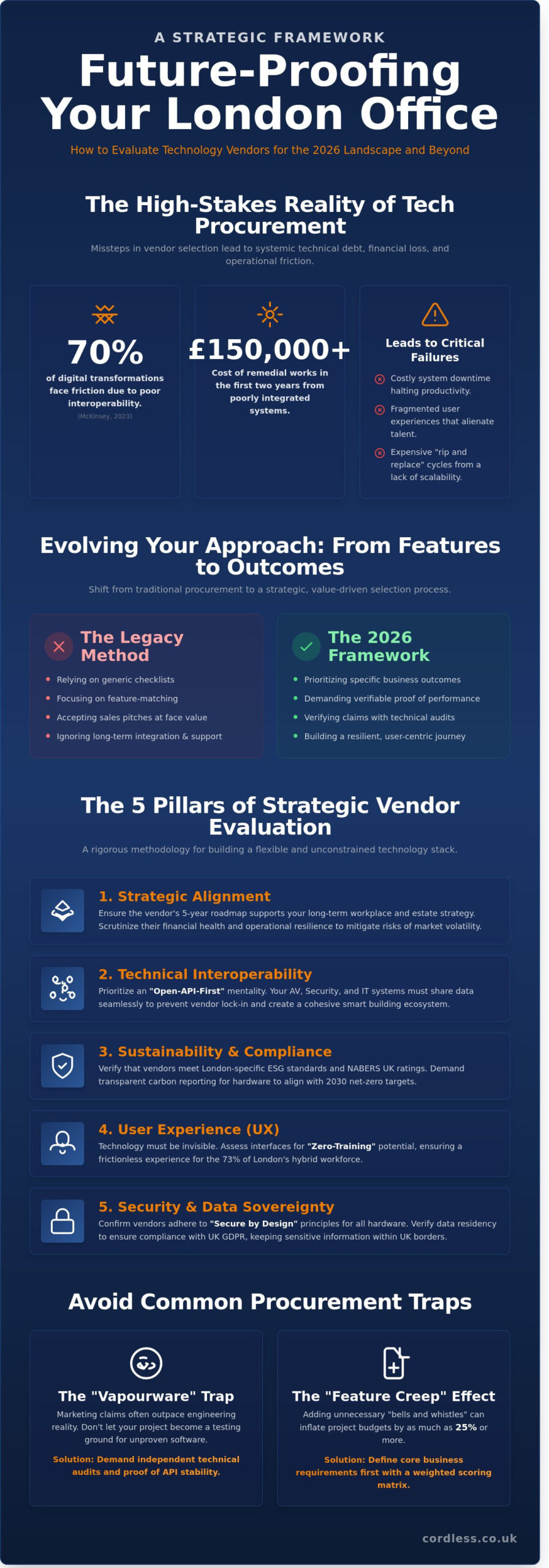
What if the technology meant to future-proof your London office actually leaves you tethered to a legacy system by 2027? It’s a common risk, as a 2023 McKinsey study found that 70% of digital transformation initiatives encounter significant friction due to poor interoperability. You likely recognise that the pressure to innovate often leads to rushed procurement, resulting in opaque pricing models and the trap of vendor lock-in. To effectively evaluate technology vendors for the 2026 landscape, you need more than a generic checklist. You require a strategic framework tailored to the specific complexities of the London commercial built environment.
This guide provides a rigorous, independent methodology to master the art of technical selection. We’ll show you how to ensure your IT, AV, and security systems integrate seamlessly with existing building management systems, rather than working against them. You’ll gain the insights needed to build a defensible procurement case for the board while creating a resilient, user-centric workplace journey. We’ll move from broad strategic concepts to the practicalities of risk management, ensuring your technology stack remains flexible and your organisation remains unconstrained.
Why Technical Vendor Evaluation in London is High-Stakes
In the 2026 London commercial market, the decision to evaluate technology vendors has evolved from a simple procurement task into a high-level strategic risk-mitigation process. For the built environment, the stakes are exceptionally high. A misstep doesn’t just result in a poor tool; it creates systemic technical debt. Industry data suggests that remedial works to fix poorly integrated systems can cost an organisation upwards of £150,000 within the first two years of occupancy. We view evaluation as the foundation of a resilient workplace journey.
To effectively evaluate technology vendors, leadership teams must pivot toward outcome-based procurement. Traditional feature-matching is often a race to the bottom that ignores actual business value. Instead, focus on the specific human and operational results you need to achieve. Whether it’s a 15% reduction in energy consumption or a seamless desk-booking experience for 2,000 employees, the technology must serve the objective. A robust supplier evaluation process ensures that every component of your smart building stack is verified for performance, security, and longevity.
Failure in this area leads to more than just financial loss. It results in:
- Costly system downtime that halts productivity.
- Fragmented user experiences that alienate talent.
- Expensive “rip and replace” cycles due to lack of scalability.
The Complexity of the London Commercial Landscape
London presents unique architectural friction that global vendors often overlook. Integrating 2026 AI-driven occupancy sensors into a Grade II listed building in the City requires a different approach than a fit-out in a modern Canary Wharf tower. Legacy infrastructure and thick masonry in historic districts can stifle wireless signals and data flow. One-size-fits-all solutions rarely survive these local constraints. You need partners who understand the specific engineering nuances of the London market.
Moving Beyond the Sales Pitch
The current smart building market is saturated with “vapourware,” where marketing claims outpace actual engineering capabilities. It’s easy to promise AI-driven optimisation, but it’s harder to deliver it. We prioritise independent technical audits to verify vendor claims. We don’t rely on glossy brochures; we demand evidence of API stability and hardware reliability. Verifying these details early prevents your project from becoming a testing ground for unproven software.
The 2026 Framework to Evaluate Technology Vendors
London workplaces are no longer static environments. To effectively evaluate technology vendors, you must look beyond the immediate feature set. A vendor’s five-year roadmap must mirror your own workplace evolution. If their development cycle lacks agility, your infrastructure will likely stagnate by 2028.
Financial health is paramount. In a market where a significant portion of tech firms face volatility, assessing long-term viability is a risk management necessity. Utilising a Strategic Vendor Selection Framework ensures you scrutinise more than just the balance sheet. It demands proof of scalability and operational resilience.
- Strategic alignment: Does their vision support your long-term estate strategy?
- Technical interoperability: AV, Security, and IT systems must share data through open APIs.
- Sustainability: Vendors must meet London-specific ESG standards and NABERS UK ratings.
Integration is the new standard. We look for “open-API-first” mentalities that prevent vendor lock-in. For London firms, compliance with building standards is non-negotiable. Vendors should provide transparent carbon reporting for every piece of hardware to align with 2030 net-zero targets.
Prioritising User Experience (UX)
Technology should be invisible. For the 73% of London employees working in hybrid patterns, friction is the enemy of productivity. We assess vendor interfaces on their “zero-training” potential. If a meeting room system requires a manual, it’s a failure. The goal is a seamless transition from the home office to the Square Mile.
Security and Data Sovereignty
Physical and cyber security have converged. Every smart sensor is a potential entry point. We require vendors to demonstrate “Secure by Design” principles in their hardware. Data residency is equally critical. Under UK GDPR, London enterprise clients must ensure data remains within UK borders. Our independent workplace technology consultancy helps verify these technical claims to protect your reputation and operational integrity.
Your Strategic Vendor Selection Checklist
Strategic alignment begins with absolute clarity. You must define your core business requirements before you evaluate technology vendors to prevent “feature creep.” This phenomenon often inflates project budgets by 25% through the addition of unnecessary bells and whistles that don’t serve your primary goals. Develop a weighted scoring matrix tailored to your London site. This ensures that critical factors, such as local connectivity standards or specific building regulations, carry the most weight in your final decision.
Rigour is essential during the selection process. Conduct a Proof of Concept (PoC) in a controlled environment to validate performance claims. A 2023 study by the Standish Group highlighted that projects using clear prototypes are 3x more likely to succeed. Finally, perform deep-dive technical due diligence. You need to understand the vendor’s support structure and their roadmap for the next 36 months to ensure their vision matches your own.
The Tender and Procurement Phase
Draft a punchy, impactful RFP. Avoid open-ended questions that allow for vague marketing responses. Instead, demand transparency through specific technical benchmarks. Focus on the Total Cost of Ownership (TCO) rather than the initial sticker price. Industry analysis indicates that up to 60% of a system’s cost is realised after the initial purchase through maintenance and licensing. Identifying these costs early ensures your budget remains resilient and predictable.
Evaluating Support and Service Levels
Reliability is non-negotiable in a high-stakes London workplace. Confirm whether the vendor maintains a dedicated support presence in London or the South East. When you evaluate technology vendors for support, local engineering availability is the most critical metric for hardware-heavy deployments. Test their response times during the procurement phase. If a vendor is slow to respond when they’re trying to win your business, they won’t improve once the contract is signed.
Ready to refine your procurement strategy? Partner with our independent consultants to build a future-proof workplace.
Why Independent Advice is the Ultimate Future-Proofing Tool
Vendor-led designs carry an inherent risk of bias. When an installer or manufacturer leads your strategy, the solution often reflects their sales targets rather than your specific operational needs. This creates a conflict of interest that can lead to proprietary lock-in and inflated long-term costs. Independent consultants provide the objective oversight necessary to evaluate technology vendors based on merit and performance alone.
Cordless acts as a strategic partner to de-risk complex office relocations and digital migrations. Data from the 2024 BCIS report indicates that London office fit-out costs can exceed £200 per square foot; misaligned technology choices often waste up to 15% of that capital. Expert project management ensures that your infrastructure remains flexible as workplace trends evolve toward 2026. We focus on the intersection of people and technology, ensuring every system serves the user journey.
- Objective oversight removes hidden commissions and biased hardware recommendations.
- Professional project management reduces the risk of costly delays during relocation.
- Strategic alignment ensures your tech stack supports long-term business goals.
The Value of Vendor-Agnostic Design
True innovation thrives on “best of breed” solutions. A vendor-agnostic approach allows you to select the most effective components from various providers to create a seamless, integrated ecosystem. This neutrality creates a competitive environment during the tendering process. When you evaluate technology vendors through a neutral lens, you gain significant leverage, often securing commercial terms that reduce initial CAPEX by 10% to 20%.
Next Steps for Your London Project
Success begins with a comprehensive technology audit. Establishing a clear baseline of your current assets allows you to identify gaps and opportunities for optimisation. Your next step is to engage a strategic partner who can manage the end-to-end procurement journey. This collaborative approach transforms technology from a utility into a powerful agent of change, untethering your organisation from outdated systems and physical constraints.
Future-Proof Your London Workplace Strategy
Navigating London’s complex commercial landscape requires more than just a standard checklist; it demands a shift toward long-term resilience. By 2026, the ability to effectively evaluate technology vendors based on interoperability and user-centric design will separate thriving organisations from those burdened by technical debt. Success relies on aligning your procurement with the specific demands of the South East professional services market, ensuring every system integrates seamlessly into your unique built environment.
Since 1994, Cordless has operated as a premier independent consultancy within the UK’s most iconic commercial developments. We provide the technical rigour and vendor-neutral perspective required to cut through market noise and turn complex infrastructure into a strategic advantage. It’s about more than hardware; it’s about creating a workplace journey that inspires your people while protecting your capital investment. Our deep roots in the South East professional services landscape ensure your strategy is grounded in decades of proven delivery.
Optimise your technology procurement with independent advice from Cordless
The future of work is yours to shape, and with the right strategic partner, your technological transition will be both seamless and rewarding.
Frequently Asked Questions
What is the most important factor when you evaluate technology vendors?
Strategic alignment is the most vital factor when you evaluate technology vendors. It’s essential to find a partner whose technical roadmap mirrors your 2026 workplace vision. Technical specifications are necessary; however, cultural fit ensures the solution actually works for your people. A 2024 industry report found that 62% of IT project failures stem from poor strategic alignment rather than technical flaws.
How long does a typical technology vendor evaluation take for a London office?
Expect the process to last between 8 and 12 weeks for a standard London office project. This period allows your team to evaluate technology vendors through initial market scanning, detailed RFP stages, and hands-on proof-of-concept testing. Larger smart building projects in the City or Canary Wharf frequently require the full 12-week cycle to ensure rigorous due diligence before final contracts are signed.
Should I choose a global vendor or a local South East specialist?
Choose a local South East specialist if you prioritise rapid on-site support and deep knowledge of London’s unique building constraints. Global vendors offer consistency for international portfolios, but they often lack the agility needed for complex London fit-outs. Recent surveys indicate that 74% of London facilities managers prefer local partners for their ability to navigate specific local logistics and planning regulations.
How do I handle vendor evaluations during an office relocation?
Start your vendor evaluations at least 6 to 9 months before your move-in date to ensure technology is integrated into the base build. Relocations have fixed deadlines that don’t bend for procurement delays. Early selection allows you to coordinate with architects and consultants from the beginning of the project. This proactive approach prevents the costly variations that occur when technology is treated as an afterthought.
What are the risks of using a vendor-led technology design?
The primary risks are inherent bias and a lack of interoperability between different systems. When a vendor designs the solution, they’ll naturally prioritise their own proprietary products over the best-in-class options for your needs. This often creates “vendor lock-in,” making future upgrades more difficult. Research indicates that vendor-neutral strategies can reduce long-term lifecycle costs by 15% compared to closed, single-brand ecosystems.