

Technical Due Diligence: Securing Your London Workplace Technology Investment
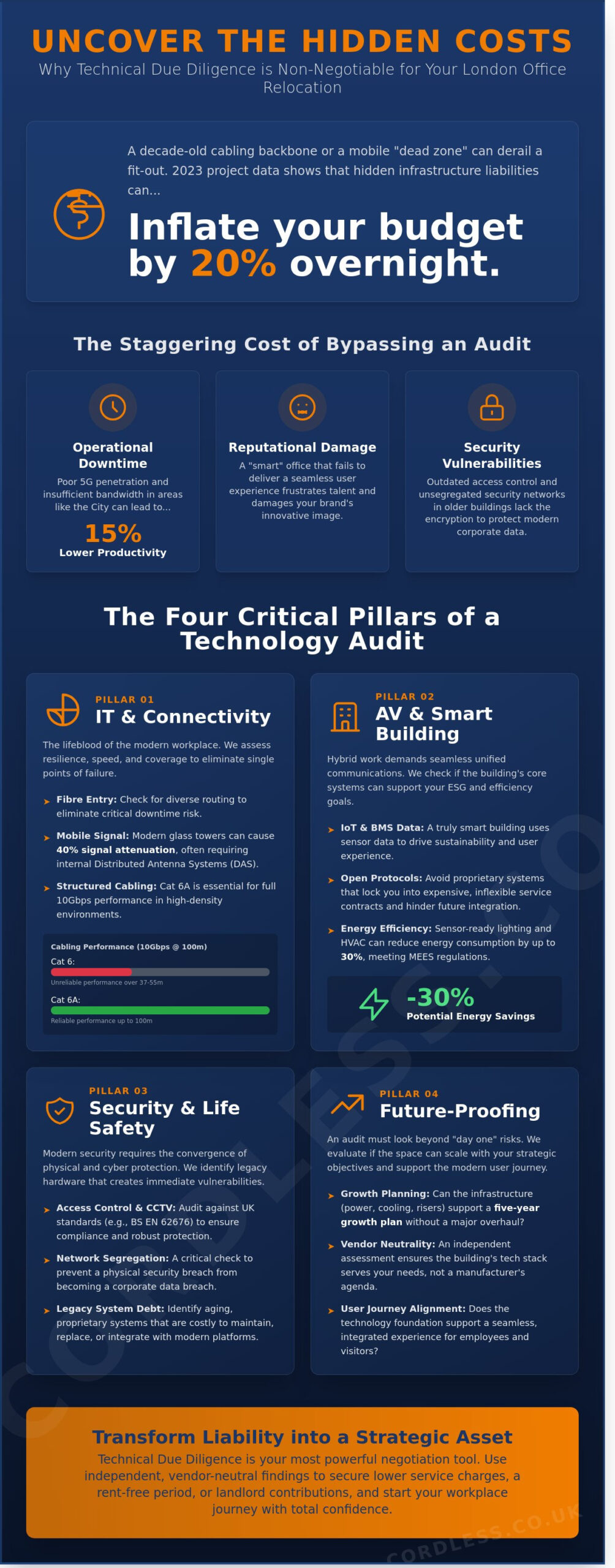
A £2 million office fit-out in the City can be derailed by something as invisible as a decade-old cabling backbone or a “dead zone” in mobile connectivity. While a building’s aesthetic might impress, the underlying infrastructure often hides liabilities that, according to 2023 project data, can inflate your budget by 20% overnight. This is why rigorous technical due diligence is no longer optional; it’s the foundation of a commercially sound lease agreement in today’s competitive London market.
You likely already recognise that a modern workspace is only as effective as the technology that powers it, yet the uncertainty of smart readiness often creates friction during high-stakes negotiations. We’ll show you how to uncover these hidden infrastructure risks and future-proof your London relocation through a structured assessment of digital health. You’ll gain a clear roadmap for accurate budget forecasting and the technical evidence needed to secure a more favourable lease with total confidence.
Key Takeaways
- Learn to evaluate a building’s complete technological ecosystem—including AV, security, and smart readiness—before committing to a London lease.
- Identify the hidden infrastructure risks specific to London’s varied architectural postcodes to avoid costly surprises during your office relocation.
- Optimise your negotiation power by conducting technical due diligence during the Heads of Terms phase to uncover legacy system constraints.
- Understand how independent, vendor-neutral expertise eliminates bias and provides a clear, de-risked roadmap for a high-performing workplace.
- Transition from basic IT audits to integrated technology strategies that align your physical workspace with the modern user journey.
Defining Technical Due Diligence for London’s Commercial Real Estate
Technical due diligence is a financial safeguard for workplace technology investments. It’s the systematic evaluation of a building’s technology infrastructure before a firm commits to a lease or purchase. In the competitive London market, this process goes far beyond checking internet speeds. A robust audit encompasses audiovisual systems, physical security, and the building’s readiness for smart technology integration.
Effective technical due diligence identifies “day one” risks that could halt an office launch. It also exposes long-term technical debt, such as aging copper cabling or proprietary security systems that are costly to replace. For occupiers, this report is a powerful negotiation tool. If an audit reveals that a building in Canary Wharf requires £300,000 in remedial network works, the tenant can use these findings to negotiate lower service charges or a significant rent-free period.
Why TDD is Non-Negotiable in 2026
High-performance connectivity isn’t a luxury in 2026; it’s the foundation of the hybrid model. With 85% of London organisations now operating on a flexible basis, the demand for seamless video conferencing and cloud access is absolute. Legacy systems in older London stock often fail to meet modern cybersecurity standards or the energy efficiency requirements of the 2023 MEES regulations. Technical due diligence ensures that your chosen space can support a modern workforce without requiring a total infrastructure overhaul within 12 months.
The Cost of Skipping the Audit
The financial consequences of bypassing a technology audit are often staggering. We’ve seen occupiers face unforeseen expenditures exceeding £1.2 million for cabling and power upgrades post-occupancy because the original risers were at capacity. Beyond the capital hit, operational risks include:
- Operational Downtime: Insufficient bandwidth or poor 5G mobile penetration in the City can lead to 15% lower productivity during peak hours.
- Reputational Damage: A “smart” office that fails to deliver a seamless user experience frustrates talent and damages the brand’s innovative image.
- Security Vulnerabilities: Outdated access control systems in older buildings often lack the encryption needed to protect modern corporate data.
By identifying these gaps early, businesses transform technology from a potential liability into a strategic asset. A thorough audit ensures the workplace journey starts with confidence, not a series of expensive technical corrections.
The Four Critical Pillars of a Technology Audit
Effective technical due diligence treats a building as a living, integrated ecosystem rather than a collection of siloed hardware. Cordless approaches every audit through a vendor-neutral lens, ensuring an objective assessment that prioritises your strategic objectives over specific manufacturer agendas. We evaluate whether a space can scale with a five-year growth plan, focusing on the vital intersection where people meet technology. This holistic view prevents the common mistake of inheriting a “legacy debt” of systems that cannot communicate with one another.
IT Infrastructure and Connectivity
Connectivity is the lifeblood of the modern London workplace. We assess diverse routeing for fibre entry to eliminate single points of failure, alongside the resilience of the local exchange. Our audits scrutinise existing structured cabling; while Cat 6 supports 10Gbps at limited distances, Cat 6A is essential for full 100-metre performance in high-density environments. We also map mobile signal strength. Modern glass towers in the City often suffer from 40% signal attenuation, necessitating internal DAS (Distributed Antenna Systems) to maintain seamless communication for a mobile-first workforce.
Audio Visual and Smart Building Readiness
The shift toward hybrid working requires meeting rooms that support unified communications effortlessly. We analyse the Building Management System (BMS) for its ability to harvest data via IoT sensors. A truly smart building uses this data to drive sustainability, potentially reducing energy consumption by 30% through sensor-ready lighting and HVAC systems. Assessing these capabilities early ensures the building supports your long-term ESG targets. We look for open protocols that allow for future integration, avoiding proprietary systems that lock you into expensive, inflexible service contracts.
Security and Life Safety Systems
Security is no longer just about physical locks; it’s about the convergence of physical and cyber protection. We audit access control and CCTV systems against UK standards such as BS EN 62676, identifying legacy hardware that creates immediate vulnerabilities. If a building’s security network isn’t properly segregated, it poses a significant risk to your corporate data. Identifying these gaps allows you to optimise your workplace journey while mitigating operational risk. We ensure that life safety systems are not only compliant but also ready to integrate with wider building notification platforms for a more resilient workplace environment.
Navigating London’s Unique Infrastructure Risks
London’s architectural landscape is a patchwork of technical risk. Generic audits often fail because they ignore the hyperlocal variables that define the capital’s commercial real estate. In the Square Mile (EC postcodes), you’ll find high-density fibre paths, yet securing a wayleave agreement for new connectivity frequently takes 12 to 16 weeks. Contrast this with the South Bank, where developing infrastructure requires a different strategic approach to redundancy. Robust technical due diligence maps these postcode-specific profiles to ensure your operational timeline remains intact.
The West End presents a different set of hurdles. Grade II listed buildings dominate this market, offering prestige at the cost of flexibility. These heritage sites often lack the floor-to-ceiling heights required for modern containment. Without a bespoke assessment, you risk inheriting a space that cannot support the cooling or cabling needs of a modern workforce. We treat every building as a unique technical puzzle, ensuring the physical constraints don’t stifle your digital ambitions.
The ‘Faraday Cage’ Effect in New Builds
Modern high-efficiency glass is a triumph of sustainability but a disaster for mobile connectivity. The metallic coatings used to meet thermal regulations often block 4G and 5G signals, creating a Faraday Cage effect that leads to signal attenuation of up to 30dB. We’ve seen teams move into “Grade A” spaces only to find their mobile devices unusable. Technical due diligence identifies these dead zones early. This allows you to budget for internal Distributed Antenna System (DAS) solutions or mobile signal boosters before the fit-out begins. Identifying this requirement early prevents a 40% cost premium associated with retrofitting technology into a finished ceiling void.
Legacy Challenges in Period Properties
Heritage offices in Mayfair or Soho rarely align with high-density tech requirements. Many of these buildings are capped at power densities as low as 50W per square metre, which is insufficient for modern server rooms or intensive AV setups. Cooling is equally problematic; the lack of external plant space often limits your ability to scale hardware. Technical due diligence uncovers hidden asbestos or structural limits that prevent cabling runs. By exposing these “hidden” costs during the pre-lease phase, we help you negotiate more favourable terms or seek alternative sites that actually support your growth. It’s about ensuring the charm of a period property doesn’t become a technical anchor.
Executing the TDD Process: A Strategic Timeline
Timing determines your leverage. Engaging in technical due diligence during the ‘Heads of Terms’ phase allows you to negotiate from a position of informed strength. If a building requires £75,000 in unforeseen infrastructure upgrades, you need that data before the lease is signed; not three months into a fit-out. Our process moves rapidly from high-level documentation audits to granular physical inspections, ensuring no digital stone is left unturned.
Phase 1: Desktop Review and Documentation
We begin by scrutinising the digital paper trail. A 2023 market analysis indicated that 45% of London commercial buildings hold incomplete or outdated ‘as-built’ drawings. We analyse O&M manuals and service level agreements for building-wide internet and security systems. Identifying gaps in these records often signals poor historical maintenance, allowing us to predict future reliability issues before you commit to the space.
Phase 2: On-Site Physical Inspection
Theory meets reality in the risers and comms rooms. We conduct visual inspections of rooftop plant spaces and technology entry points to ensure the physical infrastructure matches the landlord’s claims. Our team tests actual data throughput against advertised speeds. It is common to find 1Gbps connections delivering only 60% of their capacity due to antiquated hardware; a discovery that can save an organisation thousands in immediate rectifications.
Phase 3: The Technical Due Diligence Report
The final output is a punchy, executive-level report that prioritises clarity over jargon. We categorise findings into High, Medium, and Low risk categories to help your board make rapid decisions. This report translates technical flaws into a clear financial roadmap, detailing ‘Day 1’ essential spends versus ‘Year 3’ lifecycle replacements. We also highlight smart building opportunities, such as sensor-integrated lighting, that could improve energy efficiency by 22% based on current London benchmarks.
Our independent experts help you navigate these complexities with calm confidence. Partner with us to secure your workplace technology investment and ensure your new London headquarters is future-proof from the moment you receive the keys.
De-risking Your Relocation with Independent Expertise
Navigating the London property market requires an objective lens. Cordless provides this through 30 years of experience in the capital’s commercial real estate sector. Our independence is your greatest asset. We don’t sell hardware, so our advice remains free from the bias of sales targets or vendor quotas. We focus entirely on your business outcomes rather than shifting inventory.
Our technical due diligence reports bridge the gap between technical granularity and executive strategy. We ensure your C-suite understands the commercial risks while your IT team gets the technical depth they require. This clarity allows for informed decision-making that aligns your physical office space with your digital ambitions. We’ve seen every building type in London, from heritage Grade II listed refurbishments to the latest smart towers in the City, giving us the context to spot red flags that others miss.
Bridging the Gap Between Real Estate and IT
Technical risks often manifest as unexpected capital expenditure. A lack of diverse fibre entry points or inadequate cooling in a comms room can lead to remedial costs exceeding £100,000 if discovered too late. We translate these technical hurdles into clear business impacts. Our consultants work alongside architects and project managers to weave technology into the building’s fabric during the early design stages. This collaborative approach ensures that IT infrastructure supports your workplace design instead of dictating its limitations. We transform technology from a potential bottleneck into a primary driver of workplace agility.
Your Next Steps in the London Market
The most successful relocations begin before the lease is signed. Engaging a technology consultant during the building selection phase allows you to leverage technical due diligence as a powerful negotiation tool. It provides the evidence needed to request landlord contributions or rent-free periods based on identified infrastructure deficits. Once the site is secured, these findings form the foundation of your wider workplace technology strategy, ensuring your investment is future-proof.
When you are ready to transition from strategy to the physical build, you can check out Excel Business Environments Ltd for expert assistance with your office refurbishment and turnkey fit-out requirements.
Don’t leave your digital future to chance in a competitive market. Secure your next move with a Cordless Technology Audit and ensure your London investment is built on a resilient, high-performing foundation.
Secure Your Strategic Advantage in the Capital
Navigating London’s complex commercial real estate landscape requires more than just a vision; it demands the certainty that only a rigorous technical due diligence audit provides. By addressing the four critical pillars of AV, IT, Security, and Smart Building design during the early stages of your relocation, you avoid the hidden infrastructure risks that often lead to unforeseen costs. Cordless delivers 30 years of London consultancy experience, providing independent, vendor-neutral advice that aligns your technology with your people’s needs. We’ve spent three decades ensuring that the workplace journeys of London organisations are built on robust, scalable foundations.
Our experts guide you through every technical nuance, from legacy cabling issues to integrated smart systems, so your investment remains future-proof. It’s time to move with confidence and clarity. Book a Technical Due Diligence Audit for your London relocation to ensure your next workspace is ready for the future of work. You’ll gain a partner dedicated to turning your technological challenges into a seamless, high-performing environment.
Frequently Asked Questions
What is the primary goal of technical due diligence?
The primary goal is to identify hidden infrastructure risks and capacity limitations before you commit to a property lease. By conducting technical due diligence, you ensure the building can support your specific IT, AV, and smart technology requirements. This process protects your investment by uncovering potential deal-breakers, such as inadequate power supply or poor connectivity, that could lead to unexpected costs post-occupation.
How long does a technical due diligence audit take for a London office?
A standard audit typically requires 5 to 10 working days from the initial site visit to the delivery of the final report. While the physical inspection of a 20,000 sq ft office might only take one day, the subsequent analysis of landlord documentation and capacity calculations requires more time. This timeline ensures our consultants provide an evidence-based assessment of the building’s digital readiness and long-term viability.
At what stage of a property move should we conduct TDD?
You should initiate TDD during the site selection phase, ideally before signing the Heads of Terms. Engaging in technical due diligence at this juncture allows you to compare multiple short-listed properties based on their technological merit. It prevents the common mistake of discovering infrastructure bottlenecks after legal commitments are made, giving you the leverage to walk away or negotiate fixes with the landlord.
What are the most common technical risks found in London offices?
Inadequate power density and lack of diverse telecommunications entry points are the most frequent issues we encounter. Many older London buildings provide less than 50W/m² for tenant power, which fails to support modern high-density trading floors or intensive server rooms. Additionally, 35% of surveyed sites lack true resilience in their fibre routes, creating a single point of failure that threatens business continuity for digital-first organisations.
Can TDD help us negotiate a better lease or rent-free period?
Yes, a detailed report provides the empirical evidence needed to negotiate capital contributions or extended rent-free periods. If we identify that the building’s existing cabling is obsolete or the cooling systems are insufficient for your tech stack, you can request the landlord remediates these issues at their cost. Data-driven findings often result in lease incentives worth £50,000 to £250,000 for mid-sized London office refurbishments.
Is TDD only for large corporate acquisitions?
No, any organisation taking more than 5,000 sq ft of office space should invest in a technical audit. While a global bank’s requirements are complex, a smaller creative agency still relies on robust Wi-Fi and seamless video conferencing. The scale of the assessment scales with the property size, but the fundamental need to mitigate risk remains constant regardless of the organisation’s headcount or annual turnover.
What is the difference between a building survey and a technology TDD?
A building survey focuses on the physical structure and mechanical systems, while a technology TDD evaluates the digital infrastructure and user experience systems. While you can learn more about South Surveyors for professional property assessments—checking for damp or structural cracks—we assess 10Gbps connectivity, AV integration potential, and smart building sensor readiness. We bridge the gap between the physical shell and the high-performance digital workplace your employees expect to use daily.
How much does a technical due diligence report cost?
Fees for a professional technology audit in London generally range from £3,500 to £8,500 per property. The exact cost depends on the square footage and the depth of the smart building analysis required. While this represents a small fraction of a typical £1,000,000 fit-out budget, it provides the strategic insurance needed to avoid multi-million pound mistakes in infrastructure procurement and delivery.