
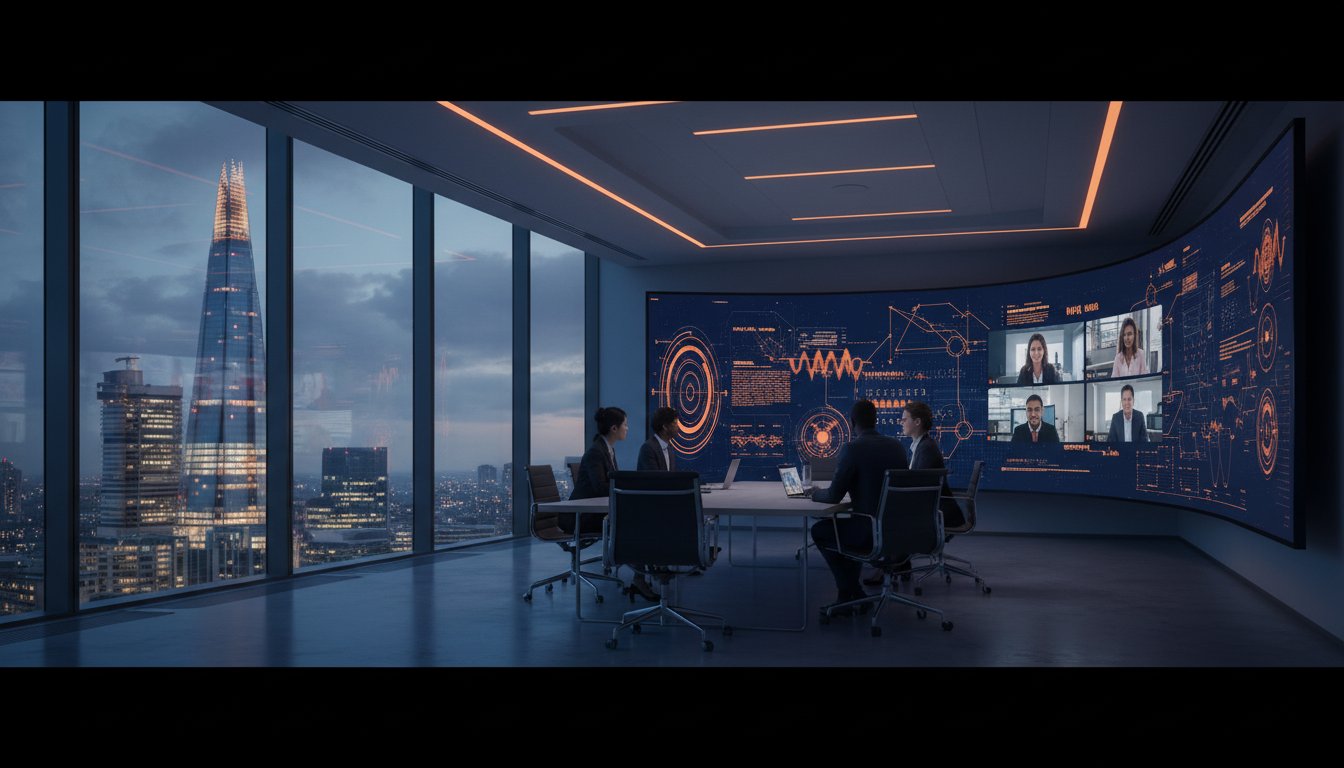
Meeting Room Technology Design in London: A Strategic 2026 Guide
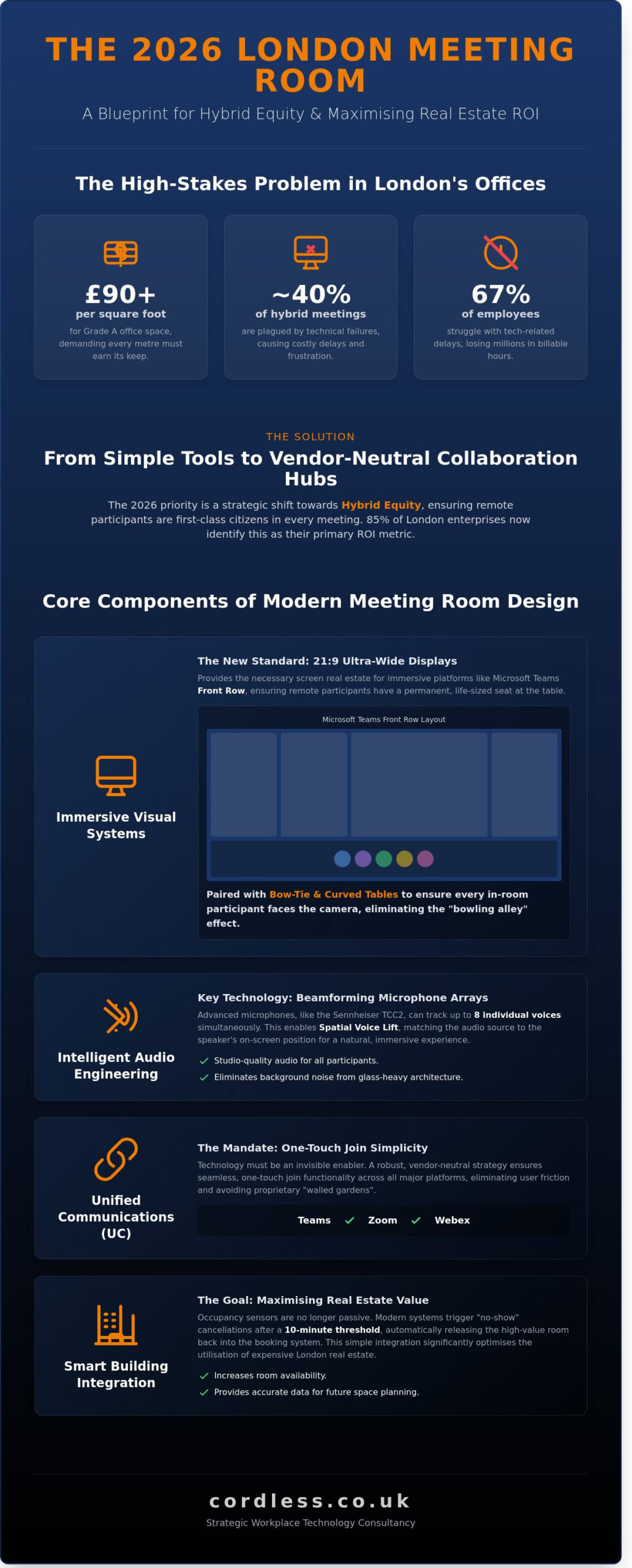
With Grade A office space in the City of London now exceeding £90 per square foot, every square metre of your workplace must earn its keep. It’s a sobering reality that, despite these overheads, nearly 40% of hybrid meetings are still plagued by technical failures. You’ve likely experienced the frustration of a boardroom full of executives waiting while someone struggles to bridge the gap between a Microsoft Teams invite and a Zoom-native room.
We believe technology should be an invisible enabler rather than a source of friction. By focusing on a strategic meeting room technology design, you can transform these underutilised spaces into high-performing hubs that prioritise hybrid equity. This guide provides a vendor-neutral roadmap to help you navigate platform fragmentation and secure a robust 5-year infrastructure plan. We’ll explore how to align your technical strategy with your 2026 business goals, ensuring your London real estate delivers genuine value for your people and your bottom line.
Key Takeaways
- Learn why effective meeting room technology design must evolve from simple presentation tools into vendor-neutral collaboration hubs that prioritise hybrid equity.
- Discover how to optimise immersive visual systems and spatial audio to ensure remote participants feel as present and engaged as those in the room.
- Understand the risks of proprietary “walled gardens” and why independent strategy is essential to avoid over-specced, rigid systems that limit future flexibility.
- Gain practical insights into navigating London’s unique architectural landscape, from heritage constraints in Westminster to modernising power and data in older building stock.
- Realise a seamless workplace journey by bridging the gap between IT, Facilities, and the C-suite to deliver future-proofed environments built for the 2026 landscape.
The Evolution of Meeting Room Technology Design in London
Meeting room technology design has moved beyond the simple installation of a screen and a camera. It’s now a strategic, vendor-neutral discipline that bridges the gap between physical architecture and digital workflows. While the history of video communication shows a trajectory of hardware improvements, the 2026 collaboration hub prioritises the human element. London’s corporate landscape, from the skyscrapers of the City to the creative studios of Soho, demands bespoke AV and IT integration that reflects specific brand identities. We often see an Experience Gap where high-end hardware fails because it lacks a user-centric strategy. Research indicates that 67% of employees struggle with tech-related delays, costing UK businesses millions in lost billable hours every year.
Why Strategy Must Precede the Interior Design
Waiting until the floorboards are down to consider cabling is a costly mistake. Early-stage consultancy de-risks office relocations by ensuring the technical infrastructure supports long-term digital transformation. Retrofitting AV into finished spaces typically inflates project budgets by 30% due to remedial works. By aligning meeting room technology design with the architectural vision from day one, we create seamless environments where the hardware disappears into the design. This proactive approach ensures that every pound spent on the interior contributes to a functional, future-proof workspace.
The 2026 Hybrid Reality in the City and West End
London’s primary business districts face unique challenges in 2026. High density requires robust connectivity and advanced signal management to avoid interference. As 82% of London firms now enforce return-to-office mandates for at least three days a week, the demand for superior acoustic quality has surged. Offices must become destinations that justify the commute. This means providing meeting environments that offer a better experience than a home office, featuring studio-quality audio and immersive visual arrays. Effective meeting room technology design ensures that hybrid collaboration feels natural, regardless of whether a participant is in Mayfair or working remotely.
Core Components of Modern Meeting Room Design
Effective meeting room technology design is no longer about mounting a screen to a wall; it’s about engineering an ecosystem where hardware vanishes into the workflow. In 2026, 85% of London enterprises prioritise “meeting equity” as their primary ROI metric. This shift requires a move away from passive hardware toward active, integrated systems that support both physical and digital participants with equal weight.
- Visual Systems: High-equity, 21:9 ultra-wide displays are the new standard, providing the necessary real estate for Microsoft Teams Front Row and immersive gallery views.
- Audio Engineering: Beamforming microphone arrays, such as the Sennheiser TCC2, now track up to 8 individual voices simultaneously, using spatial voice lift to match audio to the speaker’s on-screen position.
- Unified Communications (UC): One-touch join functionality must operate across multiple platforms, ensuring a seamless transition between Teams, Zoom, and Webex without user friction.
- Smart Building Integration: Occupancy sensors now trigger “no-show” cancellations after a 10-minute threshold, automatically releasing the room back into the booking system to optimise high-value London real estate.
By embracing the hybrid office, organisations can bridge the gap between physical presence and digital participation. Success lies in the realisation that technology must serve the human experience. A well-executed workplace technology strategy ensures these components work in harmony, rather than in silos.
Achieving Hybrid Equity through Front Row Design
Modern layouts have moved beyond the traditional rectangular boardroom table. Bow-tie and signature curved designs are the 2026 standard for hybrid-first spaces. These shapes ensure every person in the room faces the camera directly. Technical placement of eye-level cameras between dual displays facilitates natural eye contact, ensuring remote participants have a permanent, life-sized seat at the table. This configuration eliminates the “bowling alley” effect where local participants look at each other rather than their remote colleagues.
While technical layout is paramount, the ergonomic quality of the furniture remains a cornerstone of meeting equity; for those seeking high-end seating solutions, you can check out The Office Company.
Acoustics and Lighting: The Unsung Heroes
London’s glass-heavy architecture, particularly in the City and Canary Wharf, creates significant acoustic challenges. Hard surfaces reflect sound, leading to listener fatigue for remote attendees. Integrating acoustic treatments, such as PET felt panels or bespoke fabric baffles, into the interior design is essential. Lighting must also be professional grade; we specify a minimum of 500 lux on participants’ faces to ensure high-definition video clarity. This avoids the “shadowed face” look common in offices that rely solely on overhead architectural lighting.
The Pitfalls of Vendor-Led Meeting Room Solutions
Accepting a “free” design from a manufacturer is a common trap that often results in over-specced, rigid environments. Manufacturers naturally prioritise their own hardware cycles over your specific operational requirements. This leads to proprietary walled gardens that struggle in a multi-platform world. By 2026, 85% of London enterprises will require seamless switching between Teams, Zoom, and Webex; a feat that vendor-locked systems rarely achieve without significant friction. True meeting room technology design demands a vendor-neutral stance to select best-of-breed components that actually talk to each other.
The “plug-and-play” promise is another misconception that falters at scale. While a single device might work in a home office, an enterprise deployment involves complex network security, EDID management, and remote monitoring requirements. Without independent oversight, these systems often become “plug-and-pray” installations that fail during high-stakes board meetings. We focus on the intersection of hardware and human experience to ensure the technology supports the user journey rather than dictating it. Transitioning away from reactive hardware procurement toward a proactive video conferencing strategy is now essential for organisations that want to break free from vendor lock-in and poor user adoption cycles.
Understanding Total Cost of Ownership (TCO)
Initial capital expenditure is only the tip of the iceberg. You must factor in cloud licensing, firmware updates, and the inevitable 3 to 5 year refresh cycle. In 2026, the Total Cost of Ownership for AV infrastructure will be defined as the aggregate of the initial purchase price plus a cumulative 24% annual overhead for software maintenance, energy consumption, and technical support over a 60-month period. Poor interoperability creates hidden costs; a 10-minute delay in a 500-person organisation can bleed over £150,000 in lost productivity annually based on current London salary averages.
The Value of Independent Procurement
Independent procurement serves as a safeguard for your budget and your vision. Rigorous technical auditing often uncovers redundant hardware in vendor quotes, allowing us to reduce initial CapEx by 15% to 20% on average. We manage the tender process to ensure genuine apples-for-apples comparisons between integrators. This level of scrutiny protects your interests during the physical installation, ensuring the contractor delivers the exact performance standards specified in the original meeting room technology design. It’s about maintaining control of the project from the first sketch to the final commission.
Navigating London-Specific Design Constraints
Deploying sophisticated meeting room technology design in London requires navigating a complex layer of architectural history and strict regulations. In Grade II listed spaces across Westminster or Southwark, drilling into original masonry is often prohibited. Our designers opt for bespoke, floor-supported AV mounts or integrated furniture solutions that house hardware without compromising structural integrity. These non-invasive methods ensure 2026-standard connectivity within 19th-century shells, and for clients who wish to explore Full House Renovations for their wider property portfolios, such expertise ensures heritage preservation is never compromised.
Older building stock frequently suffers from restricted riser capacity and limited floor voids. We solve this through high-density PoE (Power over Ethernet) systems, which significantly reduce the reliance on heavy copper cabling. Logistics in the City of London remain a hurdle; 85% of landmark sites now require “just-in-time” deliveries and 48-hour security clearance for all on-site technicians. Success depends on meticulous project management that accounts for these micro-locational friction points.
Sustainability and the Circular Economy
Achieving BREEAM Outstanding or WELL Platinum status hinges on hardware selection. We specify energy-efficient displays that consume 30% less power than 2023 models. Modular meeting room technology design allows for component-level upgrades, extending hardware lifecycles to seven years and diverting electronic waste from landfills. Smart occupancy sensors now automatically trigger deep sleep modes when rooms remain vacant for over 10 minutes, directly supporting corporate ESG targets.
Smart Building Strategy and IoT Integration
Integration with London smart grids allows offices to shed load during peak demand. By 2026, Wi-Fi 7 provides the 40 Gbps throughput necessary for untethered, high-fidelity holographic presence. Data harvested from IoT sensors informs real estate decisions, often enabling firms to reduce their physical footprint by 15% through better space utilisation. This intelligence transforms the office from a static cost centre into a dynamic, responsive asset.
To ensure your infrastructure meets these rigorous standards, consult our workplace technology experts to plan your next London project.
Partnering with Cordless for Your Workplace Journey
Cordless Consultants Limited acts as the vital strategic link between IT, Facilities, and the C-suite. We’ve spent 30 years delivering complex technology projects across the London market, ensuring that physical spaces and digital infrastructure work in perfect harmony. Our role is to translate high-level business aspirations into tangible, high-performing environments.
Independence is the foundation of our consultancy. We don’t sell hardware or partner with specific manufacturers. This neutrality allows us to provide objective, future-proof meeting room technology design that serves your specific commercial goals rather than a vendor’s sales quota. We guide you through a rigorous lifecycle: from the initial audit and strategic roadmap to technical design, procurement, and post-occupancy evaluation.
Our methodology focuses on longevity. We help organisations realise a return on investment by choosing scalable solutions that adapt as workplace trends evolve toward 2026 and beyond. You gain a partner that manages risk, controls costs, and ensures your technology stack is an asset, not a hindrance.
Strategic Design and Project Management
We translate business requirements into robust technical specifications that construction teams can actually follow. Our approach prioritises User Experience (UX) design to manage staff transitions effectively. By bridging the gap between construction cycles and operational IT timelines, we ensure a seamless handover. Your teams walk into a space where the technology feels intuitive and works from day one.
Next Steps for Your Office Refurbishment
The demand for hybrid-ready spaces is surging, with 75% of London organisations now prioritising video-enablement in every meeting room. Now is the time to audit your estate to identify gaps in your current infrastructure. Engaging Cordless for a feasibility study or strategy session provides the clarity needed for a successful 2026 rollout. We help you untether from legacy constraints and embrace a more flexible, integrated future.
Ready to optimise your workplace? Book a technology audit with the Cordless team today.
Defining Your 2026 Workplace Strategy
Navigating the complexities of meeting room technology design requires more than just hardware procurement. By 2026, London’s most successful organisations will have moved beyond restrictive, vendor-led solutions that often ignore the specific architectural constraints of the capital’s heritage and modern office stock. Success lies in a user-centric approach that balances seamless integration with long-term flexibility. Organisations that pair this approach with a clearly defined video conferencing strategy for the 2026 built environment are best positioned to deliver measurable ROI on their property investments.
Cordless brings over 30 years of independent consultancy expertise to your workplace journey. Our London-based team leverages global project experience to ensure your infrastructure remains robust and adaptable. We maintain a strictly vendor-neutral stance; this ensures our advice is always objective and focused solely on your business outcomes. We’ve delivered strategic guidance for major projects across the city, helping clients realise the full potential of their smart building investments through evidence-based decision-making.
Discover how Cordless can transform your workplace technology strategy
The future of your office is an opportunity to untether from legacy systems and create an environment where your people can truly thrive.
Frequently Asked Questions
What is the most important factor in meeting room technology design?
User experience is the most critical factor, as 15% of meeting time is typically lost to technical friction. We focus on creating a frictionless journey where users can launch a call in under 10 seconds. This requires a user-centric approach that prioritises intuitive interfaces over complex, feature-heavy hardware that often goes unused.
How much should we budget for meeting room technology in a London office?
Budgeting for London offices in 2026 typically requires £8,000 to £12,000 for a standard huddle space and £45,000 to £120,000 for a high-spec boardroom. These figures cover professional-grade displays, audio arrays, and integration costs. We recommend allocating 15% of your total fit-out budget to technology to ensure the physical environment supports modern digital workflows.
What is Hybrid Equity and why does it matter for our design?
Hybrid equity ensures that remote participants have the same visual and auditory presence as those physically in the room. This matters because 80% of UK knowledge workers now operate in hybrid models, making inclusive meeting room technology design essential for collaboration. We use 21:9 aspect ratio displays and AI-driven cameras to ensure every face is seen clearly at eye level.
Can we use the same technology across huddle rooms and boardrooms?
You should standardise the user interface, but the hardware must scale to the physical volume of the room. While a small huddle space thrives with an all-in-one video bar, a 16-person boardroom requires discrete beamforming microphones and dual 85-inch screens. Consistency in the software layer ensures your team doesn’t need to relearn how to start a meeting in different zones.
How do we ensure our meeting room tech is future-proof for 5 years?
Future-proofing requires a transition to software-defined AV systems and high-bandwidth Category 6A cabling. By 2026, 90% of workplace technology will rely on cloud-based updates and AI optimisations. We design infrastructure that handles 10Gbps speeds, ensuring your hardware remains compatible with software evolutions through 2031 without requiring a full rip-and-replace.
Do we need a consultant if we already have an architect and fit-out firm?
Independent consultants provide the technical depth and vendor neutrality that generalist firms often lack. We bridge the gap between architectural aesthetics and IT functionality, ensuring your £250,000 AV investment isn’t compromised by poor acoustics or incompatible network security. Our role is to protect your interests and ensure the technical delivery matches the strategic vision.
What are the common mistakes to avoid in corporate AV design?
Neglecting room acoustics is the most frequent error, as glass-walled rooms often suffer from 1.5-second reverberation times that ruin audio for remote callers. Another mistake is “over-speccing” rooms with complex control panels that intimidate users. We’ve found that 40% of support calls result from overly complicated systems that haven’t been designed with the end-user in mind.
How does meeting room technology integrate with smart building systems?
Modern systems integrate via API protocols to share real-time occupancy data with your Building Management System. This allows for automated HVAC and lighting adjustments based on actual room usage, which can reduce energy consumption by up to 22%. By 2026, your meeting room sensors will be the primary data source for optimising your entire London real estate footprint.